Tag: gallup poll
Corruption Emerging As A Top Election Issue, Thanks To Donald Trump

Corruption Emerging As A Top Election Issue, Thanks To Donald Trump

For the first time in decades, anger over corruption is a topline issue in a national election, according to major polls. While Americans have long regarded the federal government as infested with crooks, they're suddenly taking names and kicking – uh, demanding accountability.

What the polling also shows very clearly is that we owe this overdue change to President Donald J. Trump, whose self-serving misconduct has enraged most voters.

For a journalist who has reported on corruption across the political spectrum for decades, this revival of civic consciousness is refreshing (and a bit stunning). To be honest, I’ve spent countless hours poring over dusty records to expose misconduct by politicians of both parties, often without arousing much electoral indignation. Two years ago, I published The Longest Con, a book that tells how Trump and his predecessors have ruthlessly ripped off the public and their own followers.

But that was then --and now feels very different.

Three weeks ago, Gallup released a new poll finding 89 percent of Americans, a record high, believe that government corruption is endemic, an increase of 10 percent over 2025.

That total includes 91 percent of Democrats 90 percent of independents, 83 percent of Republicans – and coincides with Trump’s return to the White House. Many other polls have reported similar results in recent months, notably a September UMass-Amherst poll showing that 97 percent of respondents perceive corruption in Washington; an August Ipsos poll that found “overwhelming bipartisan majorities” agree; and a survey conducted by the Brennan Center for Justice which showed 97 percent consider corruption “a big systemic problem” in our politics and government.

Recent polling also suggests that voters have observed the explosive corruption pouring billions into Trump family accounts with growing disgust. Nearly 70 percent of respondents to a Reuters/Ipsos poll in August said Trump “inappropriately” uses presidential power to reap personal profits. Almost simultaneously, a UMass-Amherst poll showed that 53 percent identified the presidency as the “most corrupt” element in a broadly tainted federal government. And this month, a poll by The Economist and YouGov said that C-word is most frequently chosen by voters to describe Donald Trump.

Nobody who covers government, including me, would claim that Democrats as a party are exempt from the crimes and misdemeanors afflicting officialdom. But what we have seen with Trump and the Republicans surrounding him is so disproportionate and brazen as to dwarf whatever came before. In this cycle, we have dozens of Republicans– notably including Maine Sen. Susan Collins – come under plausible suspicion of misconduct or worse.

That may be why Democrats stand to benefit from the renewed public concern over grift and graft. According to the latest survey by Rasmussen Reports, a pollster notorious for its Republican skew, “the Democratic Party is more trusted than Republicans to deal with corruption, an issue most voters say will be important in their midterm vote.”

Should the Democrats win both houses of Congress, they will need to end the stock trading that harmed the reputations of leaders in both parties, among other reforms. And they must fulfill the promise by Rep. Robert Garcia (D-CA), who would head the House Oversight Committee under a Democratic majority, to investigate “the Trump crime family."

Handwringing over how to confront Trump's corruption and misconduct probably led to his second term. No more dithering, Democrats.

Joe Conason is founder and editor-in-chief of The National Memo. He is also editor-at-large of Type Investigations, a nonprofit investigative reporting organization formerly known as The Investigative Fund. His latest book is The Longest Con: How Grifters, Swindlers and Frauds Hijacked American Conservatism (St. Martin's Press, 2024). The paperback version, with a new Afterword, is available wherever books are sold.

Gallup Poll: Public Satisfaction With Health Care Costs Hits New Low

Gallup Poll: Public Satisfaction With Health Care Costs Hits New Low

Public satisfaction with the cost of health care plans has hit a record low in a new Gallup poll released Monday—just as GOP legislation begins to go into effect, increasing costs for millions.

The poll found that just 16 percent of respondents are satisfied with the costs of health care—the lowest recorded number in the 24 years that the pollsters have asked the question. In fact, 29 percent of respondents said that cost is the “most urgent national health problem,” followed by access to care at 17% and obesity at eight percent.

Following the passage of President Donald Trump’s “One Big, Beautiful Bill,” Affordable Care Act subsidies are set to expire at the start of 2026, effectively raising the cost of health care for millions. And KFF estimates that, for people with marketplace plans, premiums will double if the credits expire.

No Democrats voted for the bill in the House or Senate.

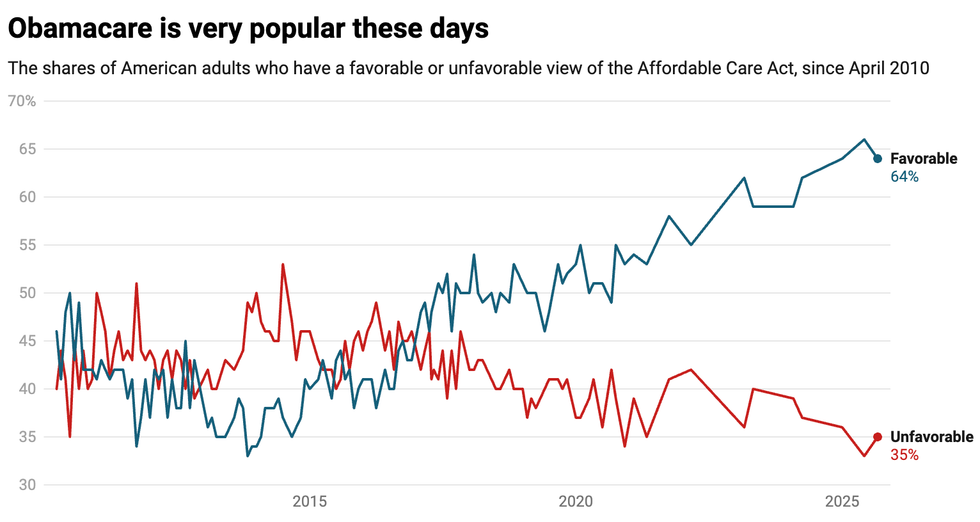
Respondents who answered "Don't know" are excluded.Chart: Andrew ManganSource: KFF Health Tracking PollCreated with Datawrapper
...

Republicans have also opposed legislative attempts to fix the premium problem before the new year.

On December 11, Senate Republicans opposed a Democratic bill that would have added a three-year premium extension, meant as a stopgap until further congressional action. The proposal was filibustered by the party majority with a vote of 51-48 preventing further debate.

The defeat of the bill falls in line with decades of GOP opposition to health care reform. The party has spent more than a decade trying to repeal the ACA and has failed to offer a serious alternative.

At the same time, Trump has argued that the issue of affordability—which includes concerns about health care costs—is a hoax invented by Democrats. This is not true, and—as polls are showing us—Americans know it.

Reprinted with permission from Daily Kos

Gallup Poll: Americans Moving Away From Republican Party

Gallup Poll: Americans Moving Away From Republican Party

More Americans now affiliate themselves with the Democratic Party than the Republican Party, marking the first time this has happened since January 2024, according to a Gallup poll released Thursday.

Gallup finds that in the second quarter of 2025, an average of 46 percent of Americans say they identified as a Democrat or a Democratic-leaning independent, compared with the 43 percent who say they are a Republican or Republican-leaning independent.

That's a change from the first quarter of the year, when an equal 45 percent of Americans identified with either party. And it's an even bigger shift from the fourth quarter of 2024—when last year’s presidential election took place—when 47 percent identified as Republicans.

Gallup said that the shift is not unexpected since the party in power usually sees voters turn away from it in the first few months of a new administration.

"Shifts in party affiliation away from the ruling party have occurred in the first year of most recent presidential administrations. The current movement in party preferences is primarily driven by a greater share of political independents saying they lean toward the Democratic Party," Gallup said.

Still, the Democratic Party has a lot of work to do to improve its image.

Gallup also finds that just 34 percent of Americans view the Democratic Party favorably, which is the lowest rating for the party since Gallup first asked the question, in 1992. The GOP performs only marginally better, with 38 percent viewing it favorably.

Gallup said that Democrats' poor image is thanks to Democratic identifiers viewing their own party in an unfavorable light—likely because they want to see their party leaders fight harder against Trump’s shredding of the Constitution and the GOP’s cruel policies and evil attempts at stealing power.

"Seventy-three percent of Democrats now have a positive opinion of the party. This is down sharply from 87 percent in the prior reading in November and contrasts with a 91 percent favorable rating of the Republican Party among Republican identifiers," Gallup said.

Indeed, it’s why Democratic Sen. Cory Booker of New Jersey unleashed on his fellow Democrats on the Senate floor on Tuesday, saying, “The Democratic Party needs a wake-up call.”

“It's time for Democrats to have a backbone. It's time for us to fight. It's time for us to draw lines,” Booker said.

- YouTube youtu.be

Still, despite the Democratic Party’s struggles, Gallup added that the shift in party affiliation away from the GOP is likely a worrying sign for Republicans going into the 2026 midterms.

In each of the past few midterm elections, "midterm losses were preceded by shifts in party affiliation away from the ruling party during the president’s first year in office," Gallup wrote.

For example, in 2017, when Trump first took office, Republicans saw a two-percentage-point decline in the number of people who affiliated with their party. In the next year’s midterms, a blue wave led to Democrats regaining control of the House.

And in 2009, when Barack Obama first entered the White House, Democrats saw a 5-point drop in the number of Americans affiliated with the party between the first and fourth quarters of the year. A year later, Republicans romped to victory in the 2010 midterms.

At the end of the day, the laws of thermostatic politics still stand.

Reprinted with permission from Daily Kos

American Constitution

Despite The Idiocy And Ignominy, I'm Still A Patriot

On the eve of our nation's 249th birthday, a Gallup poll finds that only 58 percent of Americans feel "extremely" or "very" proud of their country. This is a new low in the 25 years Gallup has been asking this question, and the reasons are not hard to divine. We are led by a monomaniacal vulgarian who endangers all we hold dear — all while enjoying lock-step fealty from the Republican Party.

We are clearly in a rough patch, but rather than despair, we can draw upon our rich history for inspiration.

First a disclaimer: America has been responsible for appalling savagery in the past 250 years. There is no sugar-coating our sins, but as Immanuel Kant said, "Out of the crooked timber of humanity, no straight thing was ever made."

America is the greatest nation in the history of the world. And here are a few of the reasons.

We are the oldest democracy on the planet, having set the template for self-government and rule of law that has been such a gift to humankind. Our freedom, vast territory, culture and institutions give the freest possible rein to human creativity and flourishing.

We have been a haven for the oppressed for centuries. My grandparents fled the Russian and Austro-Hungarian Empires to find freedom and security here just as millions upon millions of others did. Search the history of almost any American and you will find ancestors, often quite recent, who uprooted themselves to partake of the bounty and freedom on offer here.

Most were not famous names, but boy, are there a lot of renowned refugees who found their way here: Albert Einstein, Vladimir Nabokov, Nikola Tesla, Mikhail Baryshnikov, Igor Stravinsky, Kurt Godel, Irving Berlin, Martina Navratilova, Andrew Carnegie, Sergey Brin, Oscar de la Renta, Zbigniew Brzezinski, Artur Rubinstein, Gloria Estefan, and Thomas Mann. The list is virtually endless.

They brought their talents to our shores and accomplished great things because this pulsing, energetic, inventive and risk-taking republic provided the platform for greatness, undergirded by political stability.

Are you grateful for air conditioning this July 4? Thank an American, Willis Carrier. Are you planning a road trip? You can enjoy any of 63 national parks because the United States invented the national park, starting with Yellowstone.

Let's hear it for airplanes, the telephone, the personal computer, the internet, recorded sound, the elevator, anesthesia, the cellphone, the polio vaccine and other medical marvels — all invented by Americans.

America has also given the world jazz, hip hop, stand-up comedy, Hollywood, community colleges, root beer, basketball, baseball, Broadway musicals, skyscrapers, public libraries, summer camp, and the ice cream cone. The United Nations is basically an American idea supported disproportionately over the years by American contributions. Ditto for the International Monetary Fund and the World Bank. Until recently, Americans could be proud of our humanitarian work in the world's poorest nations, to whom we were the most generous donor.

Over the years, the United States was the world's foremost first responder when other nations were struck by tsunamis, earthquakes, famines or aggression. In addition to the Marshall Plan, NATO, and PEPFAR, American might ensured that Berlin remained a free city when the Soviets imposed a blockade, supplied Israel with lifesaving munitions when Egypt and Syria launched a joint attack, defeated the aggressive Serbs and negotiated a Balkan peace, presided over the Camp David Accords, relieved a famine in Somalia, liberated Kuwait, saved the Yazidis from Mount Sinjar and much else. Though we fought a brutal war against imperial Japan and suffered terrible war crimes at their hands, our occupation was benign and fair. We transformed an enemy into a thriving democratic ally.

Our worst national stain also gave rise to our most inspiring mass movement: the civil rights struggle. We were challenged to live up to our stated creed, and though the resistance was bitter and ugly, the nation did respond and did heed our better angels. Forty-three years after Selma, we elected a Black president.

Populism, nativism, racism and, frankly, stupidity, are sprinkled liberally throughout our history. But they are subtexts, not the main story. We will transcend MAGA as we transcended the Know Nothings, the Confederacy, the anarchists, the McCarthyites and the Wallaceites (both Henry and George) — not to mention the abuses of the British Empire more than two centuries ago. On Independence Day, I will sincerely celebrate a nation that, despite its demagogues and fools, was capable of producing an Abraham Lincoln, a Franklin Roosevelt, a Frederick Douglass, a Wendell Willkie, a Martin Luther King Jr., a Learned Hand, a Dwight Eisenhower, and a Herbert Hoover (that's right, for saving millions from starvation after World War I).

Adam Smith said, "There's a great deal of ruin in a nation," and we've had too many recent occasions to rue that reality. But this week we need to remember the nobility of this nation. There's a great deal of that, too.


Mona Charen
is policy editor of The Bulwark and host of the "Beg to Differ" podcast. Her latest book is Hard Right: The GOP's Drift Toward Extremism.

Reprinted with permission from Creators.

Shop our Store

Headlines

Editor's Blog

Trending

World